Whole kitchen · Bellevue
Breaker Drops as the Viking Oven Heats Up
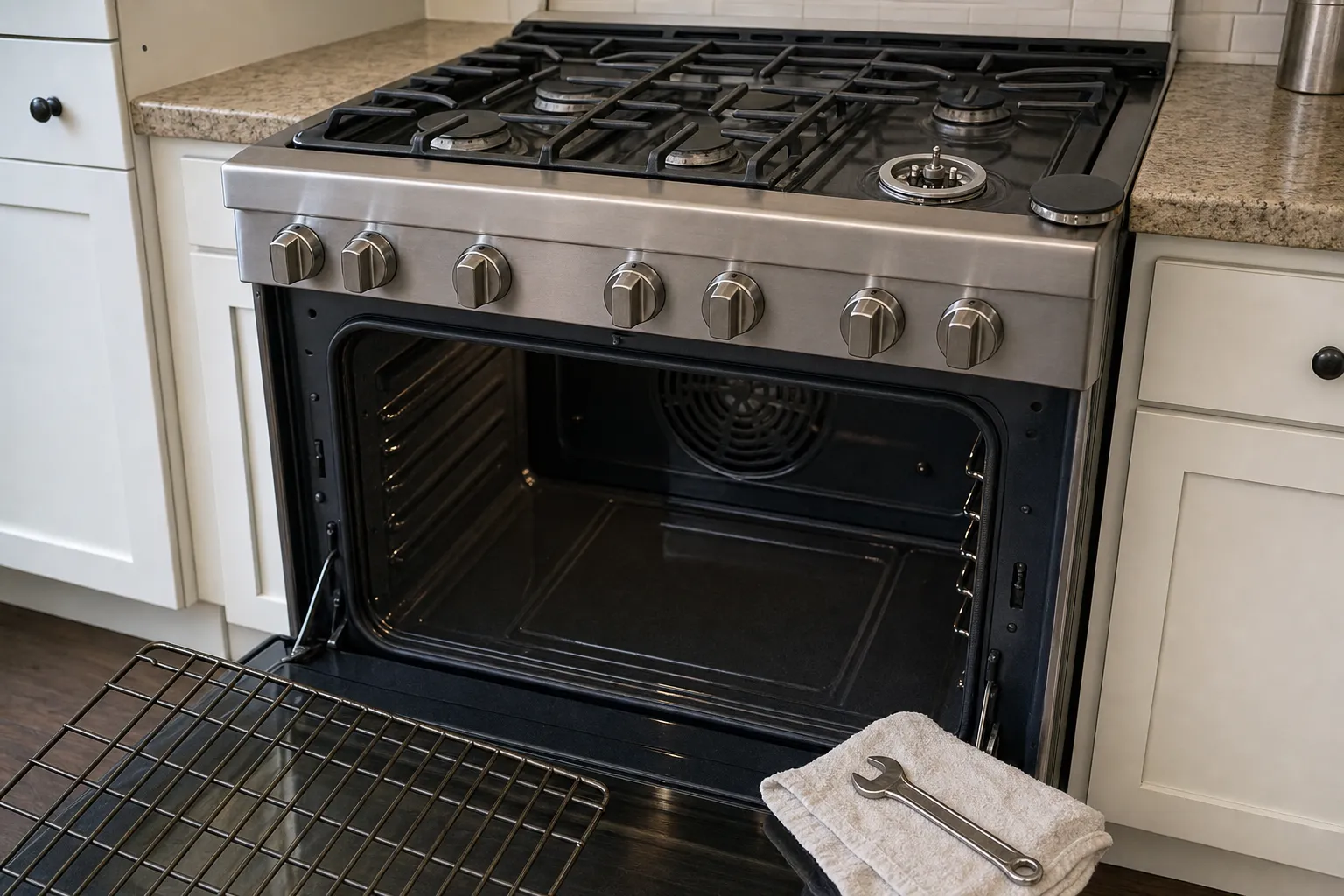
When a Viking electric oven in a Bellevue kitchen trips its breaker as it comes up to heat, what we usually find is an element that has broken down inside its sheath and is shorting to the frame. Wiring and the breaker itself come after that. Viking Repair Bellevue works out which from the setting that tripped it, on (425) 696-2636.
What we usually find
- Most often
A heating element shorting to its outer sheath. It often shows as a blister, a split or a bright spot on the element, and the trip comes on whichever setting uses that element.
- Sometimes
A wiring fault: a terminal that has cooked loose or a lead rubbed through where it passes the frame. The trip tends to follow heat and time more than any one setting.
- Rarely
The breaker itself, worn after years of carrying a heavy load. It drops on every setting, sometimes before the oven has had a chance to draw much at all.
The setting is the clue
On Viking’s 5 Series and 7 Series built-in ovens each setting leans on different elements, so the one that trips the breaker narrows the search before anything is opened. TruConvec runs only the rear element behind the fan cover. High broil runs both broil elements in the roof at full power, low broil only the inner one. Bake uses the bottom element, with the broil element adding heat from above.
A trip on TruConvec but not on bake points at the rear element. A trip on broil alone points upward. A trip on everything, or only after a long spell of heat, points away from the elements and toward the wiring or the breaker.
Electric ovens, and the house circuit
This page is about Viking’s electric ovens: the built-in wall ovens and the oven under a dual-fuel range’s burners. If you would call that electric range repair, you are in the right place — the cavity heats the same way whichever name it goes by. An all-gas range that trips a breaker is a different fault; describe it when you call.
If the trouble proves to be in the house circuit rather than the oven, that part is work for an electrician.
Safe checks before you call
-
Note the setting and the timing
Write down which setting was running when it tripped and how long it had been on. Straight away and a few minutes in are different faults.
-
Clear out any foil
Take out any foil and make sure nothing metal touches an element. Viking warns against lining the oven or covering its floor, since foil traps heat.
-
Look at the elements while cold
With the oven cold and its breaker off, look at the broil element in the roof and any element showing on the floor. Leave the fan cover in place; the convection element sits behind it.
-
One reset, then leave it off
Switch the breaker fully off and on once. If it trips again on the same setting, leave it off: every reset pushes current through the same fault.
-
Stop and hand it over
If none of that changes what the Viking is doing, leave it there and ring Viking Repair Bellevue on (425) 696-2636. Tell us what you already tried; it narrows the visit before we set out.
Asked about this
Is it safe to keep resetting the breaker so I can finish cooking?
No. A breaker that trips as the oven heats is stopping a fault, most often an element shorting to the frame, and each reset sends current through it again. One reset to confirm is reasonable; after that, leave it off and cook on something else. Viking Repair Bellevue, (425) 696-2636, starts from the setting that tripped it.