Hoods and cooktops · Bellevue
Viking Hood Is Loud but Barely Pulls Steam
Noise and pull come apart as soon as the air has somewhere it cannot go. Grease-packed baffle filters, a damper that no longer swings fully open or ductwork fighting the fan all make a Viking hood sound busier while it moves less. The blower comes last on that list. Wash the filters first; if nothing changes, call Viking Repair Bellevue on (425) 696-2636.
What we usually find
- Most often
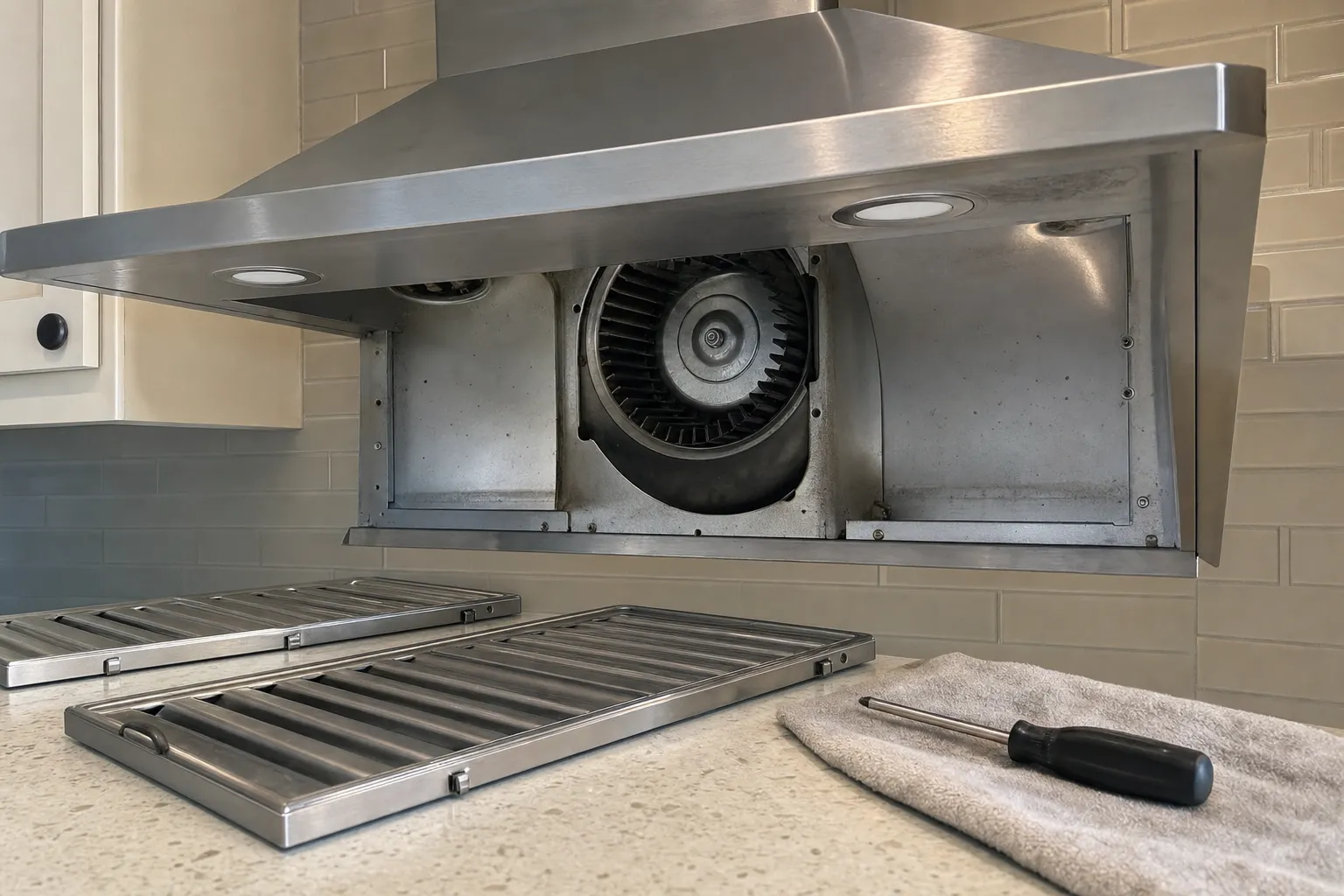
Filters loaded with grease. Viking's baffle filters catch grease in their steel channels, and once those channels are coated the hood shifts far less air for the same noise. On a recirculating hood, a charcoal filter past its time does the same.
- Sometimes
The path beyond the hood: a damper held part-shut by grease, a crushed or flexible stretch of duct, or a blocked cap outside. Viking's installation guide forbids flexible duct for the back pressure and turbulence it adds.
- Rarely
The blower itself: a wheel caked in grease that throws air poorly and runs rough, or a motor that no longer reaches full speed. Both change the sound of the hood rather than simply making it louder.
When the room is the limit
A hood can only push out as much air as the kitchen lets back in. In a tightly sealed home, and a Downtown Bellevue condo is the usual example, the fan can spin hard and move surprisingly little until a window opens. Viking’s installation guide says to ask a qualified installer or the local codes about make-up air, so that answer lies with the building or a ventilation contractor rather than with the hood.
What the visit covers
The technician starts with the filters and the blower wheel, then checks that the damper swings freely and how the duct leaves the hood. Anything on the roof needs proper access and is never a homeowner’s job.
Safe checks before you call
-
Wash the baffle filters
With the fan off, slide the filters out as your manual shows and wash them in the dishwasher or a sink of hot, soapy water. Avoid caustic detergent and never take a filter apart. On 18-inch-high hoods, soak the grease trough as well.
-
Check the charcoal filter on a recirculating hood
A hood that returns air to the kitchen carries charcoal filters behind the baffles. Viking's guide says to replace them every six months to a year and keep them out of the dishwasher.
-
Crack a window and compare
With a pan steaming and the hood at your usual speed, open a window close to the kitchen. If the steam now rises cleanly into the hood, the room is short of replacement air, not the hood short of power.
-
Switch on before the pan goes on
Start the hood a few minutes before you cook, as Viking advises, and let it run a few minutes after. A hood switched on over a pan that is already steaming spends its first minutes catching up, which passes for weak pull.
-
Stop and hand it over
If none of that changes what the Viking is doing, leave it there and ring Viking Repair Bellevue on (425) 696-2636. Tell us what you already tried; it narrows the visit before we set out.
Asked about this
Why is my hood louder than it used to be?
Often because it is working against something. Grease-coated filters or a sticking damper make the air rush and swirl, and swirling air is noisy; Viking warns that flexible duct does the same. A new rattle or a change of pitch, rather than plain loudness, points more at the blower wheel or the motor. Viking Repair Bellevue, (425) 696-2636.
Can I clean the blower wheel myself?
The filters, and the grease trough where your hood has one, are yours to clean; Viking's guide shows both. The wheel sits in the housing beside the motor wiring, and Viking says the power must be off at the panel before anyone services a hood, so leave it for the visit. Viking Repair Bellevue answers on (425) 696-2636.